Our next stop from Bogota was the colonial town of Villa de Leyva. The journey offered us the most spectacular views of the Andes; the benefit of getting hot smelly buses is that it is possible to get a true sense of the country in which you are visiting. The road we used is a lifeline from the northern part of the country to the capital and it shows. Towns have popped up alongside the road which is often nothing more than dirt and a few cobbles. Countless mechanics, car garages, lorry parks and truck stops make up these towns and that is where the trade for the locals lie. The fumes from said lorries, most of which wouldn´t look out of place in a drag race, pollute the air and locals have taken to wearing surgical style masks to save their lungs. It is looking up though for the Colombians. In the next six years, the government is investing $7bn more to infrastructure, something which has only been made possible due to internal conflict dying down. If you look past this grimy facade, the countryside is absolutely breathtaking. The mountains tower so high above us they dont look real and they are beyond green due to the healthy dry and mild climate.
After six short hours (short in comparison to the distances we were covering in Brazil!) we arrived in a town which is a weekend hotspot for rich bogotanos to retreat to. The streets are cobbled and the buildings pristine with donkeys and horses tethered to trees whilst their owners enjoy a midday cerveja. Unfortunately for me, I was unable to enjoy this beautiful town due to spending 14 hours in the hospital with the end result being a kidney infection diagnosis and countless antibiotics to keep me entertained for a week. Although there is not much in the way of sights to see, the area in which Villa de Leyva sits is one of natural beauty and has a peaceful atmosphere - something I hope to come back and experience again, properly, at some point in my life.
Friday, 13 March 2015

Monday, 9 March 2015
Bogota, Colombia
After an overnight stay in Leticia, Colombia [Leticia meaning happiness in Latin], a walk back over the unassuming border to Tabatinga, Brazil for a passport stamp or two allowing us passage and then back to Colombia to catch a flight, we finally made it to Bogota, the capital of Colombia. The city's full name is Santa Fe de Bogota del Neuvo Reino de Granada de las Indias del Mar Oceano and it sits on a high plateau 2640 metres from sea level within the Andes mountain range and boy dont we know it. Having spent the last five weeks in tropical Brazil, it was a shock to the system to go to bed in thermal clothes covered by three blankets! In between leaving the airport and settling into our room, we had been told of the dangers of Bogota by three different people and came across someone who had been mugged... the city was certainly living up to the reputation left by its chequered history, leading Michael Palin to comment in his 1995 'Full Circle' book 'I would urge people to visit, but at their own risk.' Needless to say that after a comfortable nights sleep I was filled with trepidation as we ventured from the hostel towards the pilgrim destination of Cerro de Monserrate, a mountain 3152 metres above sea level dominating the skyline around Bogota. As we have been lucky enough to experience the real Colombian climate, low thick clouds blocked the view of the city and whilst we struggled to climb part of the way due to the altitude, our breaths plumed out in front of us as we huffed around the site. The 17th century church is nice if not slightly forgettable but the botanical gardens and street market made the visit for us. Stalls selling Coca Tea lined the passage way and for a measly 3000 sol we gave it a whirl. Coca leaves for both chewing and stewing in tea is a huge part of Andean culture due to the belief it has many health benefits, especially to combat altitude sickness. Despite the fact it is cultivated directly from the plant used to make cocaine, it is completely legal.
 It is even used in Coca Cola, hence the name. Wandering through the La Candelaria part of the city, a student and business based metropolitan area of the city, it seems like every other person is part of the federal police. There is a huge military presence here and these guys mean business. They bear guns the same size as their torsos and walk around with huge muscly dogs wearing heavy duty muzzles. I cant work out if all this makes me feel safer or more at risk so we hot foot it to Botero Museum, named after Colombias famous artist Fernando Botero. Whilst his art doesnt appeal to me, there were pieces on show by Picasso, Renoir, Dalí and Monet which were great to look at. I definitely now feel I could blag my way through an art based argument! Back to the hostel for the evening. It's such a shame that we cant venture out without fearing for our safety, the nightlife looks really buzzing here and what better way to practise my rusty Spanish than over a beer?! Oh well better to be safe than sorry. All in all, Bogota has reached and exceeded my expectations and proved to me that first impressions arent always right.
 It is even used in Coca Cola, hence the name. Wandering through the La Candelaria part of the city, a student and business based metropolitan area of the city, it seems like every other person is part of the federal police. There is a huge military presence here and these guys mean business. They bear guns the same size as their torsos and walk around with huge muscly dogs wearing heavy duty muzzles. I cant work out if all this makes me feel safer or more at risk so we hot foot it to Botero Museum, named after Colombias famous artist Fernando Botero. Whilst his art doesnt appeal to me, there were pieces on show by Picasso, Renoir, Dalí and Monet which were great to look at. I definitely now feel I could blag my way through an art based argument! Back to the hostel for the evening. It's such a shame that we cant venture out without fearing for our safety, the nightlife looks really buzzing here and what better way to practise my rusty Spanish than over a beer?! Oh well better to be safe than sorry. All in all, Bogota has reached and exceeded my expectations and proved to me that first impressions arent always right.
Sunday, 8 March 2015
Triple Frontier - Brazilian/Colombian border
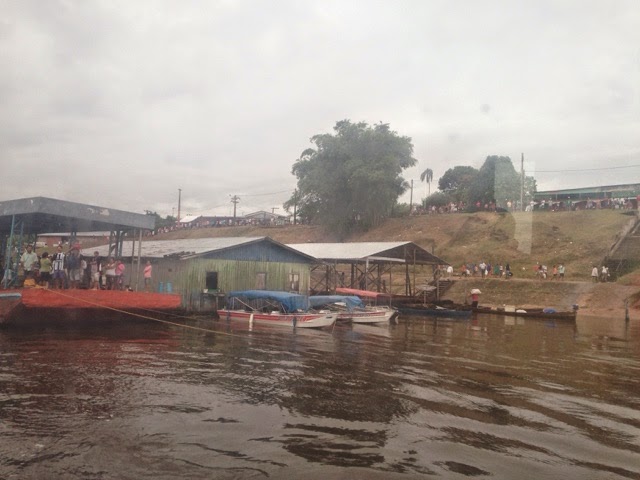
Yesterday we embarked on what is the longest journey we have made so far. It takes approximately 38 hours to take a fast-boat up the Amazon (or one of its tributaries to be precise) to reach Tabatinga, on the border with Colombia. I couldn't have been more wrong when I imagined the river to be clear cut straight up and down. The banks are eroding leaving trees and natural debris crumbling into the water and in some places the marshland, prime caiman habitat, is so vast it is impossible to see where the river ends and land starts. The width of the river is huge but broken up with islands everywhere. Over 2,000 dot the landscape and we are told it is the largest archipelago of river islands in the world. Not that dry land brings with it sights of Amazonian wildlife. For the first few hours every floating log we saw definitely could have been a caiman... But so far all we have seen is a pig, a couple of cows and lots of birds - not quite what we had hoped for but as we are quickly learning, this is the Amazon and nothing should be taken for granted. I wasn't quite prepared for just how many villages there would be along the riverside, some ranging from a couple of huts to towns big enough that they even have a version of Rio's Christ the Redeemer.
 Despite the varying degrees of development all houses seem to have a Sky satellite dish! Although settlements are frequent, none of the smaller islands have signs of human life. Brazilian law prevents anybody residing on these islands in order to protect the area of conservation. When I asked Milton, our tour guide from a few days ago, about the ever controversial topic of deforestation he assured me that local people aren't interested in destroying the forest. "Tourism is a long term investment which is guaranteed to bring in regular money. If we chop trees down we get money once when we sell and then what?" Besides it is too risky to ship logs via the river, their only mode of transport as there are no main roads leading to any other big city. Surveillance cameras would see the logs slowly being hauled down the river, something which isn't a problem on the speedy highways surrounding the Archway of Deforestation, the band which runs from west to north east and the centre of deforestation of the Amazon. The man alleged to head the logging operation was arrested last year and there has been a 65% fall in deforestation since - a move in the right direction.

This morning we had a rude awakening of the animated type as the film Frozen was blasted from the televisions. Along with the Sky TV, credit card machines in gift shops found on remote floating villages and Nicki Minaj baring from speakers everywhere you turn, it looks as if the people of the Amazon are also moving at a pace to catch up with the rest of the world. A good thing I don't know, but at least I can sing Frozen's "Let it Snow" in Portuguese now.

Wednesday, 4 March 2015
The Amazon River
8am start today ready for our big Amazon adventure. Our mode of transport for the day is a speedboat, the Focker 205, and our captain is a Amazon villager called Milton. As we speed past the city we are reminded of just how important the river is to those who live here as they whizz around on motorboats going about their daily lives.

The Amazon is formed downriver of Manaus after the confluence of the Rio Negro and the Solimoes rivers. The Solimoes is the Brazilian name for the river which starts in the Andes, the true source of the great Amazon river. There are several factors as to why the two rivers run side by side for 12km before they finally merge. Density, speed and temperature are the main reasons. The Rio Negro is a balmy 30 degrees whilst the Solimoes is only 26. I was thankful for this as we travelled upstream mid-storm as every time you get splashed, which is approximately every other wave, at least it is warm.
 Floating villages line the river and according to Milton prices are at a high. Per log, of which you need four to float a house on, it is R$10,000 (£2,200) and then building supplies on top. We visit one village and fish for Pirarucu fish, one of the biggest fresh water fish in the world. With size comes strength as they snap the dead fish bait off the end of my homemade fishing rod with absolute ferocity.
Next stop was an unassuming shack floating idly by the banks. Open the door to be greeted by a sloth, a caiman and a boa constrictor... Oh and the local dog. These creatures were greeted with varying reactions: the sloth got a hug, the caiman a hesitant stroke and the snake a scream and a run in the opposite direction.

After lunch we fed monkeys who had clocked on that humans will feed them if they pester enough. Clambering all over us, monkeys of all sizes clawed at the bananas we had swiped from the buffet table and followed us all the way to a lake where lily pads are growing. For only three days the lilies bloom at night and close in the day trapping flies inside them when closed. When they re-open, the insects fly to other lilies and voila, germination of a plant strong enough to hold an adult caiman.
The next stop was a visit to an indigenous tribe who welcomed us in native dress of body paint, leaf skirts, headwear and not much else. We were invited to join in a dance dating back to the time when their gods introduced other tribes for them to share their heritage with. All the music was played on instruments made by hand from resources found in the jungle.

Our last and most amazing experience of the tour was a swim with pink river dolphins. On Wednesdays you are not allowed to entice dolphins downstream with food (that's Brazilian law for you) so we took the trip 55km upstream to their natural habitat and got into the warm water. The mysterious mammals appeared without any sign and were all of a sudden upon us, thanks to the dark colouring of the river hiding anything under the surface. Whilst not as attractive as the typical dolphin, this variety have an unusual beauty to them. Their long noses are twisted at the ends to help search and catch fish hiding in the undergrowth and their pink colour glows under the orange tinted water. They are strong athletic creatures who easily pushed us over as they playfully fought for the fish we offered them. It was a magical moment I will never forget. Our hour long cruise home was much smoother as we were going with the flow of the river and we had uninterrupted views of the bank-side wildlife and local villagers.
Without a seconds hesitation, the Amazon has easily provided me with the best day of my life.
Manaus
Whereas Brasilia is a functional city, Manaus is a place of progression. In and around the colonial buildings built by the European settlers during the rubber boom period of the late 1800's/early 1900's are shops selling more building materials than you could imagine, forecourts offering a menagerie of brand new cars and over 500 warehouses manufacturing products for global companies such as Samsung and Volkswagen. The city itself is a huge contrast to the Rio Negro it is situated on. This river runs directly towards the Solimoes river, where for 12km they run along side each other before joining to form the Amazon river as we know it. I had never heard of 'Solimoes' but the two rivers actually have six different local names before they become the Amazon.
The riverside is dominated by shipyards enabling the two way flow of goods from land to river and vice versa. The Amazon is Manaus' lifeline providing a constant supply of products from all over the world.
During the rainy season the weather changes in an instant and our speedboat today heads into the centre of a storm. The horizon disappears behind grey dense clouds and only the methane-burning fires from oil plants break the bleak outlook. Lighting breaks above our heads as if a whip is being cracked in the clouds and thunder rumbles loud enough to shake your bones. Our guide Milton simply shrugs when we question the days weather and vaguely says "this is the Amazon, there is no forecast." Downtown there is a real hustle and bustle around us, with every street lined with clothes shops, opticians (and lots of them) and electronic stores. Everyone is trying to make a quick buck and they seem to have just the knack for it. I am in awe of the city's people working in the withering heat and humidity. Milton says the South call the people here lazy as they work at a more relaxed pace, but there is a method to that else otherwise "we would all die from the heat," he muses.
Life here is adapted to benefit as much as possible from the river. Floating supermarkets are everywhere selling an abundance of freshly caught fish, whilst the justice system has even extended to the water with floating prisons and courtrooms. Palafitas, or houses on stilts, line the river bank prepared for the inevitable rise of the water, a yearly occurrence which brings with it both good and bad. The land surrounding the river is dry and infertile for most of the year, but once the tide rises farmers can move their cattle to lower ground to make the most of the rich soil. However in 2012 the water rose so high the city was flooded and many people were displaced from their homes - hence the need for Palafitas.
Manaus has literally gotten under our skin thanks to the anti-malarials we are taking. Although the locals we have spoken with ensure us malaria is no problem here, our daily pills bring with them sleepless nights and minds that can't shut down. Hopefully we will become accustomed to them or else the next couple of months will be fun!
Monday, 2 March 2015
Brasilia
 After Lencois we travelled back to Salvador in order to catch a flight to Brasilia. Even though we were doubling back on ourselves twice it was still quicker than getting the bus over 1000km from Lencois to Brasilia. Luckily Max has friends here in the capital so we are staying in complete luxury, the complete opposite end of the scale to our shack in Lencois. Brasilia was built in the 1960s in order to replace Rio de Janeiro as the centre of government. At the time, the city was seen as futuristic and even 50 years on it is still an impressive monument to national initiative. The whole city is designed to look, from above, like an aeroplane so all the suburban areas are identical blocks broken up by commercial streets which appear to be the centre of the local areas. Thankfully we have our friends playing the part of tour guides, otherwise we would have been furiously studying the map every 10 seconds.
 In the 'fuselage' of the aeroplane are where the government buildings are, a long strip called Eixo Monumental. Spread across a 5km stretch is the Congresso Nacional, Palacio de Justica and the Museu Nacional, to name a few. Between these iconic buildings, a retro-futuristic vibe is given off thanks to the architecture of each building, designed by the famous Oscar Niemeyer, who the city's utopian layout is hailed to.
However impressive the buildings are, the word of warning from others Brazilians we have met previously seems to ring true. Apart from the governmental buildings and shopping centres, the city appears lifeless and dull. The Metro is abandoned, the streets are empty and it feels like a lost city. Brasilia didn't even celebrate carnival this year due to austerity measures (of which other city's took no notice).

But that's not to write it off completely. In the cosmopolitan Asa Sul area, the new rich elite show off their wealth at the expensive chic restaurants that line be Lago do Paranoa, the artificial lake formed in the south of the city, lined with the University of Brasilia, the Olympic centre and the Palacio de Alvorada, the home of the Brasilian president to name a few.

Sunday, 1 March 2015
Lencois
We have been in Lencois now for three days, a city 9,000 strong around an eight hour drive west of Salvador. This area is known for its national parks and more specifically it's gold and diamond mining heritage. We are staying in a small shack in the forest with bare brick walls, open gables in the ceiling, a mezzanine sleeping area with draping mosquito nets and a relaxed hammock area outside; it's also wifi free which is great.
 On the first day we went to The Serrano, a short stretch of the Lencois River where the river bed is a smooth rock surface where nature has hollowed out some swimming holes, or Calderioes (cauldrons/pot-holes) which we jumped in. The water in this area is tinged brown and some deeper parts look totally black, a colour which comes from the plants by the river beds. According to the locals, the best colour is when it looks like black tea! We explored some sand caves which seem to defy gravity with the overhanging edges and preciously stacked structures. After a walk through the town which is all cobbled streets and brightly coloured buildings, we went back to our Casa with some friends and experimented making our own Caiprinha cocktails!
 After here we drove to Gruta da Fumaca, a natural cave part of an underground system comprising of over 300 other caves. The six of us donned our hard hats and torches and made the steep descent underground until we were 50m below ground level.
After a great buffet lunch of local dishes served in a mud shack in the middle of nowhere, we headed to Pai Inacio Mountain which is another main tourist spot in the Chapada Diamontina Nacional Park.
Translated as the Diamond Highlands, this vast area covers 15,000 square miles and is bigger than Holland. In the 1700's settlements became aware of the diamond and gold under the surface and the mining began.

At one point there had been water in the gruta so where the stalactites and stalagmites had joined together there was a completely horizontal line severing the connection where the water had flowed. We were able to get up so close to these natural wonders which was so fascinating to see just how they formed so many millions of years ago. At one point Levy had us meditating in a circle in total darkness and as strange as it sounds, the silence was absolutely deafening!

Day 2 was more full on as we had organised a group guided tour. Six of us, all of whom had met in Salvador, and Levy our guide set off for a waterfall first. In comparison to the place we visited yesterday, this waterfall was more of your typical kind: a rock face which water cascading down into an open pool surrounding by huge boulders shaped by the weight of the falling water. Because of the depth of the pool the water was so black we couldn't see our hands infront of us - a very weird experience! Combine this with the spray from the waterfall and the overcast skies it had a prehistoric feel to it which was amazing.
After a great buffet lunch of local dishes served in a mud shack in the middle of nowhere, we headed to Pai Inacio Mountain which is another main tourist spot in the Chapada Diamontina Nacional Park.
At one point there had been water in the gruta so where the stalactites and stalagmites had joined together there was a completely horizontal line severing the connection where the water had flowed. We were able to get up so close to these natural wonders which was so fascinating to see just how they formed so many millions of years ago. At one point Levy had us meditating in a circle in total darkness and as strange as it sounds, the silence was absolutely deafening!
After we had climbed the 1150m to the top, we just sat and enjoyed the natural beauty of the surrounding area and also the unique flowers and plants growing atop the mountain. The surface was made up of small craters, one of which was naturally heart shaped - a great picture opportunity!

Subscribe to:
Posts (Atom)