Saturday, 2 May 2015

Huacachina

Next on the itinerary was the desert oasis town of Huacachina, close to the coastal city of Ica. The town is centred around a small lagoon lined with palm trees with huge sand dunes looming as far as the eye can see. 

Apart from wanting a few days to relax and soak up the sun, our main reason for visiting was to sandboard and dune buggy within the sprawling desert wilderness. The dune buggies are essentially monster 4x4 wheel drives kitted out with roll cages and harnesses - and not much more. Following a safety check we roared through town past copious other tourist filled buggies and hit the dunes which did not disappoint - it was so exhilarating to be thrown around the dunes, up huge peaked slopes only to be thrown over the crest and down the other side, all the while being jiggled around inside the cage! 

We made two stops during our buggying experience which was our time to sandboard. As the name suggests it is literally snowboarding adapted to the sand. A very few people are actually able to sandboard, even those who can snowboard/wakeboard/surf due to the consistency of the sand being much softer and harder to balance on. Needless to say, 90% of the thrill-seekers up there, me included, opted to toboggan down instead which is no easy feat. 

Crawling along the ridge at the top of the dune with only a board to hold on to dear life to, the only thing to do is launch off the ridge and plummet down the sand. During the six rides we did, the size of the dunes differed greatly but the last one, and the one I sustained an injury on, was in excess of 50 metres high. Due to the gradient, speed quickly picks up and the only way to slow down is to dig your feet in the sand to imitate brakes. On the first slope as I had finally come to a stop, I was trembling head to toe with adrenalin - sandboarding is a thrilling, exhilarating, blood-pumping activity not designed for the faint-hearted. 

Taking into consideration all the climbs, volcanoes and activities that South America has offered us so far, Huacachina and the Peruvain desert has definitely proved me with one of the best days of my  three months in this wonderful continent. 


Friday, 1 May 2015

Lima

Capital cities usually confuse my emotions before we arrive as most in South America have a dangerous reputation but promise the chance to spend a few days lapping up all the prospects a city has to offer. Lima is no different to this; most of the backpackers we have met couldn't give us a good review of the second driest capital city in the world. 

During the stop-start bus journey from the outskirts to the Miraflores district we were staying in, I could sense a feeling of unease as we passed through crammed, dirty, dusty and frankly quite scary neighbourhoods located around central Lima. However simply by crossing a bridge, you are transformed into another world. Colonial buildings tower around the bustling crowd of the city-dwellers capable of paying the price tag which comes with living in the desirable, upscale part of town. For the first time in three months, I saw a Starbucks Coffee and every other car seemed to be a Mercedes, Audi or Porsche; Miraflores benefits from a local government intent on improving the area to live up to the city's nickname 'Garden City.'

Besides the fact it is free, our favourite way to see a city is to take part in a walking tour. Starting from Parque Kennedy, Miraflores' central plaza, we caught the public bus across town to Lima Downtown in time to catch the changing of the guards at Government Palace, the official residency of the Peruvian president; it truly was a royal affair (excuse the pun). In the same square - Plaza de Armas, is the Cathedral and Archbishops Palace. It was interesting to see the change in architectural design following many earthquakes over the years - Lima sits within the 'Ring of Fire,' a quake-prone area on the Pacific Rim. 

Our tour guide showed us the former train station-turned-post office, the House of Literature and the Church of San Francisco, one of the better preserved churches within the city. The final stop on the journey was to a small bohemian taverna where we sampled the national drink of Pisco. The grape brandy is mixed with egg whites, sugar and syrup to create the green-tinged frothy cocktail, Pisco Sour. Peruvians take great pride in Pisco and have developed it into a culture of its own; we tried many different brands and types which have popped up over the years. I can confirm that it is just as good as the reviews make out!

(Photos to follow)

Sunday, 26 April 2015

Bienvenidos a Peru! Huanchaco

Welcome to Peru! I cant quite believe we are in Peru already. Brazil only seems like two minutes ago but they do say that time flies when you´re having fun! Fun isn´t quite the word I would use to describe our first experiences of Peru. After a tyre change high up in the Andes, our bus finally made it to the border and after a few stamps of the passport, into Peru. You could be forgiven for thinking northern Peru is an African nation, with shanty towns stretching as far as the eye can see, thick sheets of dust clinging to the piles of rubble strewn across the roads and waste disposal sites burning in the horizon. We arrived in the border town of Piura exhausted and unimpressed and as my head hit the pillow, I did a little prayer for an improvement during our trip to Huanchaco the following day.

Huanchaco reached and exceeded our expectations as we were welcomed with a sunset over a glimmering shoreline, waves lapping at the pier and tourists and locals alike soaking up the last of the afternoon sun. The beach town of Huanchaco is a haven for surfers, and travellers like us looking for some downtown. After three days of travelling on hot and smelly buses, our first day in Huanchaco was spent on the beach doing nothing but sunbathing, relaxing, reading and eating tasty homemade empanadas. 

Whereas we had been able to wind down during the daytime, our Irish hostel owners informed us of free salsa lessons at the club next door so of course we jumped at the chance! My moves, rusty from our lessons way back in Cali, Colombia, were lubricated by Pisco, the national spirit made from grape brandy and soon we were all mingling and intertwining on the dancefloor, gringos and locals alike. 

I couldnt have asked for a nicer way to spend a few days at our first ´proper´ stop in Peru. 


Friday, 24 April 2015

Quilotoa and Cotopaxi volcanoes

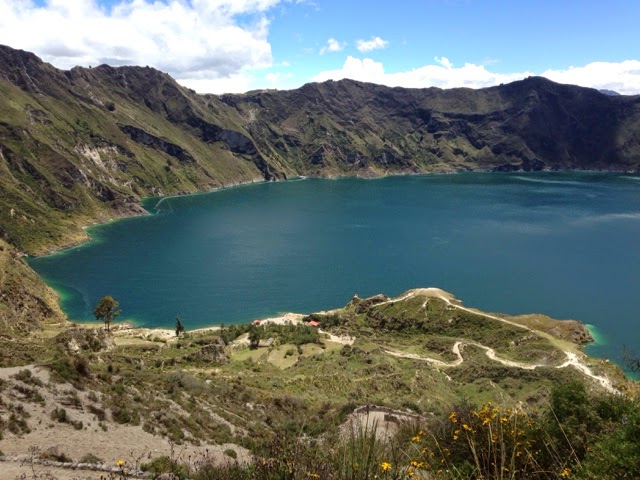
Because of the two parts of the rocky Andean mountain range that runs through the centre of Ecuador it is a haven for thrill-seeking outdoorsy types looking to scale volcanos, mountain bike, zip-line through tree canopies, and abseil down waterfalls. All of which we have been doing for the best part of a week. From Quito the first stop on our adventure odyssey was Latacunga close to both Quilotoa and Cotopaxi volcanoes. Quilotoa is an extinct collapsed volcano with a lagoon within the crater. We were lucky enough to have beautiful weather during our day which made it even more stunning - the water rippled in the breeze and sparkled in the sun and the surrounding mountains looked like brightly coloured patchwork quilts rolling in the distance. 

Next up was Parque Nacional Cotopaxi, home to the active snow capped cone of Volcán Cotopaxi, Ecuador's second-highest peak standing at 5897m. Along with our tour guide we made it through the eery mist to the first refuge point from which we began the hour ascent to the second refuge and then further on to the staggeringly huge glacier slowly forcing its way down the side of the volcano. As we heard many times en route from fellow climbers, the terrain is 'just like' the moon with jagged boulders protruding from black fine sand next to vast ravines filled with red solidified lava. Cotopaxi delivered my first experience with a glacier and it didn't disappoint. We hopped over streams of melting ice water and negotiated crevasses until we were actually inside the glacier; a surreal experience. 
I am soon realising that when climbing to heights of around 5000m altitude sickness is a serious danger. Acclimatisation is key but even so we passed several people collapsed by the side of the trail suffering with dizziness, shortness of breath and crippling headaches - a scary reminder of how beautifully dangerous Ecuadorean mountain ranges can be. 

Chimborazo Volcano

Believe it or not, we have come to our last volcano on the Ecuadorean list. And we have saved the best until last - Chimborazo, the furthest place on Earth from its exact centre and the closest place on the planet to the stars. 

Riobamba, the city nestled in its lowlands was, after a devastating earthquake in 1797, rebuilt specifically to align towards Chimborazo to enable locals to enjoy the scenery during day-to-day life. From here we loaded up our 4x4 and began the climb to the base camp, called Whymper Hut after Englishman Edward Whymper who made the first ascent in 1880. From here, the last part of our trek was only 900m in distance and 200m in elevation but took over 40 minutes due to the altitude as by now we were over 5000m, higher than Mount Blanc, the Alps' highest peak. Sadly reaching the second camp gave us no better views as the weather had closed in, covering the landscape with thick fog and a smattering of falling snow. Back down to Whymper Hut and it was time to mountain bike! Volcanic rock and debris under the tyres along with 20% visibility, biting cold and sheer drops either side of the path made the first part difficult and treacherous. Our route would be half on tarmac, half in the wilderness so after a couple of kilometres we were rewarded with a short cycle on smooth road. 
However back on the trail and the terrain had changed completely. Scrubland had taken over and huge mounds of moss-covered sharp rocks took up the paths cut out by melting glacier water. All the while traversing these rocky conditions, the steep descent means gravity takes over so you find your frozen hands gripping the brakes as if your life depending on it (ironic really). After a particularly rough section, I came off the bike and was thrown down a hill which marked the end of my short-lived mountain biking career. But the fun didn't stop there. Our tour guide turned into a off-road champion so as the others pedalled on we were hurling across the moonscape, whizzing by curious Vicuña, a protected species related to the llama/alpaca family. Their wool is so highly coveted that one kilo can fetch $800! For lunch we stopped in a ravine likened to scenes from 'The Lord of the Rings' and watched local women herding cattle, sheep and alpacas around ancient Inca ruins, all the whilst sat on an embankment soaking up the late afternoon sun. 
Although I thought I'd be a professional biker by the end of the day, turns out Chimborazo had other ideas and I, quite frankly, loved how one of my last days in beautiful Ecuador turned out.

Baños

From Latacunga we caught another local bus to Baños (pronounced banyos) which was a peaceful town full of proud Ecuadorians going about their daily lives in traditional dress, culturally uncompromised despite the towns popularity with tourists. On our first day we signed on the dotted line at the tour company and headed to one of the many cascadas, waterfalls, to begin an afternoon of canyoning; essentially abseiling down sheer waterfalls. I love outdoor activities so volunteered myself to go first, angling myself diagonally off a cliff into ice cold mountain water. Remembering all the advice, techniques and what-not-to-do's is no easy feat whilst trying to forget that dangling yourself backwards off a waterfall goes against all human instinct. BUT when I made the final leap into the swirling pool below, it was so exhilarating I just wanted to move to the next rock face. 


Three hours and about a million selfies later, we had made it to the bottom. Soaked to the skin and shivering cold, we hopped on the dirt bikes back into town and agreed it was definitely $25 well spent! 
On our second day in Baños, after a spur of the moment night out on the tiles, we went to the 'Swing at the End of the World' to try and shake off our hangover. This swing has made it into many 'top ten things to do before you die' lists so we had high hopes. Typically the Andean weather was not on our side so the 'end of the world' was out of sight but the swing itself is just abit of pure, childlike fun next to  a zip line that wouldn't look out of place in a kids playground. With only a piece of rope to keep you on the swing, health and safety obviously hasn't reached Ecuador yet but that was part of the experience. With only a small crowd, and a tenth of the adventure we have had the past few days, it was a charming quiet afternoon spent in the foothills of the towering Andes. 

Friday, 10 April 2015

Quito

When we left Otavalo I was expecting to reach Quito and be welcomed by a grimy capital city that has a reputation for being dangerous. However following a free walking tour on our first day my opinion of the worlds highest capital city dramatically improved. For three hours we visited local markets and tried the fresh produce - Moroche for me, a warm milky drink perfect for combatting the affects of the altitude sickness that I was suffering from - walked around large public squares and learnt the history of Quito, whose name derives from the word Quitu literally meaning central earth. 

Before we arrived in Ecuador I had it down as the sleepy neighbour to conflict-ridden Colombia and drug capital Peru. But it turns out the country and capital has its fair share of colourful historic stories from presidents being murdered in machete attacks to hyperinflation leading to a complete change of currency (from the Sucre to the U.S. dollar - just before the changeover the conversion rate was an astronomical 25,000 Sucre to just one dollar) Although after the tour I was suitably impressed, we had still been given regular warnings about pickpockets, crime rates and where is simply too dangerous to go in the city. Similarly to Rio de Janeiro, building and infrastructure works are popping up everywhere in and around Quito as the government and active tourism ministry 'prettify' the city. However it seems logical to me that if all efforts and energy were targeted at lowering crime and bettering the local every day quality of life, then tourists would eventually come naturally as part of the inevitable circle of exploration and adventure as more and more people are taking to travelling the world. 


As the name suggests, Ecuador sits right on the equatorial line so we ventured the 30 minutes out of the city to the Mitad del Mundo, or middle of the world. Over 500 years ago explorers were able to locate the equator using only the mountains and sun alignment and impressively managed to get it to within 300 metres. Today with the help of fancy GPS a huge red line has been painted on the exact 00°00'00" latitude where we found ourselves conducting classroom-like experiments to understand the change in hemispheres and gravity from one side of the line to the other. From balancing an egg on a pin head to watching the clockwise and anticlockwise spin of water down a plug hole, it was fascinating to feel and see the affects of natural forces which are the reason the Earth exists as it does. After we had received our diploma certificate for balancing said egg on the pin (yes really) we made our way to La Basilica, Quito's outwardly impressive cathedral. 

I found the interior to be a much of a muchness as the other churches we have visited elsewhere but La Basilica has a secret weapon in its arsenal - for an extra $2 it's possible to climb the vertical exposed steps up the actual spires to reach the highest views of the city, a UNESCO World Cultural Heritage Site located on the Andean active volcano of Pichincha  Needless to say, in the blowing wind, I didn't bother doing that choosing rather to enjoy the views from a safer slightly lower platform where I was shocked to see just how big Quito is, as it sprawls along the valley floor and banks up the sides of the looming Andes. It is easy to get swept into city life and become accustomed the the high rise buildings but, as I look out from the hostel terrace in the direction where the Amazon basin begins, I am reminded of just how naturally beautiful Ecuador is. 


(Photos to follow)