After a few days resting our weary bodies and washing our smelly clothes after Machu Picchu, we were en route to Arequipa, Peru's second biggest city. With the sun shining on roof top terraces and with some friends in tow, we spent a relaxing afternoon overlooking the city enjoying Pisco Sour cocktails. The next morning we had a 3.30am wake up call as we had a day trip booked to Cañón del Colca which is the worlds second-deepest canyon - twice as deep as the more famous Grand Canyon, and was our best chance at spotting the famous endangered Condor birds, which are among the largest flying birds in the world and can have a wingspan of up to 3.5m wide. The Condor, whilst not being a particularly good looking bird with direct relations to the vulture, are majestic icons soaring through the sky and are revered by the Peruvian nation.
As we had driven straight to the Condor viewpoint when we first arrived, we made several stops on the way back to appreciate the views of the canyon, to peruse market stalls and for me, to try cactus icecream; nice if not a little gloopy!
Tuesday, 19 May 2015
Arequipa
 The canyon ridges have been agricultural terraces since around 1200 and the crops are watered with a natural irrigation system formed directly from the melting snow from the neighbouring mountains. This creates a microclimate which enables to two groups of indigenous people to farm almost any crops. The Cabana and Collagua people are easily distinguished to a uneducated traveller by their choice of headwear - Cabana people wear embroidered hats, whereas the Coyawa decorate their headwear with knitted roses. As these two groups share the landscape and still have their pagan-esque beliefs, every August they climb the nearest mountains to give a sacrifice to Pachamama - Mother Earth - in order to get a good yield that year. This mountain was the place where Juanita was discovered in 1999. Juanita is believed to have been a human sacrifice made over 500 years ago and because of the freezing temperatures, she has been almost perfectly preserved and today resides in warmer climes in the Museo Santuarios Andinos in Arequipa. Not only is Cañón del Colca a thriving agricultural region but also a place that holds mystical legend. There are lakes on the lowest of the terraces where the water can change colour in a matter of hours encouraging local folklore to claim the lakes hold magical powers. Sadly for the believers in us, the colour change is more likely to do with the nearby copper mines than any influence from the supernatural.
Back within the city limits we found ourselves caught up in protests which have been a continual theme in Arequipa for the last four years. As far as I was able to discover the disruptions were over an oil source found at Tia Maria in the southern region of Arequipa and had brought miners, farmers and construction workers to blows. In March 2015 the riots had gathered momentum again and only four days before our arrival, two people had been killed as the protests escalated. We only witnessed peaceful demonstrations from the farmers within the city centre but as we were leaving, the threat of civil war was on the cards and with no intervention from the government, we were quite happy to be leaving - on one of the few buses that were still running, in the dead of the night away from the attention and abuse of those protesting. Although at times this had been quite a scary experience, I was glad to have been able to see past the tourist facade and into how real life is like for Peruvians and I left with sadness in my heart for those who's lives will be so drastically affected, whatever the outcome.


Machu Picchu
 Machu Picchu is one of the wonders of the world so it would be foolish to visit Peru and miss out on the Lost City. Working our way through the abundance of tour companies, packages, deals and prices, we settled on the Jungle Trek which is a four day excursion combining activities with hiking en route to Machu Picchu. Our itinerary on day one was mountain biking and white-water rafting so after a rude awakening at 3.30 we began the ascent from Cusco to our start point at just below 5000m. Still on the bus, we wound our way through the Sacred Valley passing through Ollantaytambo, the best surviving example of Inca city planning. As we climbed higher the weather took a turn for the worse pushing our start point back. Finally on the bikes kitted out with full body armour we set off and whizzed down the hairpin bends skidding round the corners on the wet tarmac and negotiating waterfalls which cut into the road. After a short uphill struggle (struggle indeed in the altitude!) we made it, three hours later, at the checkpoint for a delicious four course lunch!
Full to bursting we loaded into a collectivo and set off for the Urubamba River our start point for the rafting. In the native Quechua, the name translates as 'sacred river'
A fun, if not a cold, afternoon had by all as we navigated the waterway, were tossed around by the white water into whirlpools and splashed water at rival rafters in sister boats.
I had been a little apprehensive about this trek following our Ciudad Perdida hike in Colombia but day one surpassed expectations by keeping a hold of my enthusiasm with thrilling activities.

Day two was a little more understated as we made our way through the valley on an 18km hike. It is hard to come to terms with the stark contrast in scenery that we witnessed - at the point of two densely covered mountains meeting at the Urubamba river, the snow-capped formidable Salkantay mountain looms in the background as a reminder that this wilderness is not to be underestimated. We learned of the Chacana or the Inca Map (photo) which depicts South America and the 70,000km of Inca Trail which cuts through the continent and is still used today by those visitors who choose to follow the Inca Trail en route to Machu Picchu.
 On the final stretch of our trek we took a rickety old cable car across the swirling river - by cable car I mean a self-operated cage on a pulley system wire thrown from one river bank to the other which providing a thrill after a long walk in the blazing heat along crumbling cliff tops and over rockslides. Our final stop was at a natural hot spring site. Produced by hot volcanic water seeping through the jagged rock face, the springs were a deliciously balmy respite to the throbbing blisters that had formed during the day and with a stunning location and pebbles underfoot, this was a perfect end to a long and tiring day.

On the third day we had more activities lined up in the form of zip-lining. Although I am no pro, I have done this many times before so I was intrigued to see how it would compare in this stunning landscape and it didn't disappoint. The five lines where zigzagged over and around the raging Urubamba River below and because of the height of the initial line, all the others were on a downward slope so we whizzed down at a great speed. To top the morning off we traversed a 200m suspension bridge with only thin planks of wood to keep us on track; this was the most nerve-wrenching part!
After lunch it was time for us to begin the 11km walk along the famous train tracks from Hidroelectrica to Aguas Calientes which is situated at the foot of the Machu Picchu mountain. Hidroelectrica is exactly what it sounds like, an electricity site utilising the power of the Urubamba River. More so than this it is an eyesore in the stunning Sacred Valley, but arguably a positive development for sustainable energy.
The train track is still in use for those tourists able to afford the high prices and so during the two hour walk we had to hop off the sleepers into the jungle to avoid the bulky carriages crawling sleepily through the valley.
Aguas Calientes, named after the hot springs we visited the day before, is the epitome of a tourist trap with countless souvenir shops and overpriced restaurants convincing visitors to part from their Nuevo Sols. With a 4am start time on our last day, we needed no excuse to skip the generic gimmicky set up, head to the hostel and get as much well-earned rest as possible.
 On 'Machu Picchu Day,' we embarked on our ascent to the Lost City. An eery but excitable atmosphere took ahold of those clever (or stupid?!) enough to be stumbling to the start point at 4.30am in the pitch black with nothing but a head torch as guidance. Following a check of our tickets and passports we were finally allowed to begin to climb the 2000 steps to Machu Picchu which was HARD. The Incas built the stairway with a variety of sized steps to make the climb difficult for attackers... And inadvertently tourists some 700 years later! An hour later and soaking wet from the humidity and sweat we had arrived!! One final set of stairs to climb, a corner to round and finally we were rewarded with incredible views of the sprawling Inca site of Machu Picchu as the sun tried to shine from behind the eery low lying clouds which hugged the peaks. When the explorer Hiram Bingham discovered the site on July 24, 1911 he said: "tremendous green precipices fell away to the white water of the Urubamba below. Immediately infront... was a great granite cliff rising 2000 feet sheer. To the left was the solitary peak of Huayna Picchu surrounded by seemingly inaccessible precipices. On all sides were rocky cliffs. Beyond them snow-capped mountains rose thousands of feet above us."
For us, and all first-time visitors, a moment is needed to catch your breath upon first arriving as the views, much like Bingham described, are so impressive; it is easy to see why the Incas chose this spot to live.

During the course of the morning we explored many parts of the site including the Sun Temple which is the highest point in the whole site and therefore the most important building reserved only for meaningful events, the Temple of the Condor where a bird shaped rock was used as a place of sacrifice to ensure that Incas would make the transition into the afterlife, the Temple of the Three Windows used to locate the exact location of the sunrise,
 the quarry where they cultivated the huge building blocks with only man power to shape and move the enormously heavy slabs and the medicinal garden where they concocted remedies similar to the modern day paracetamol. Another impressive feat of the Incas was the basics of their buildings. The slabs used as bricks are held together in what is now called the "Lego technique," an overlapping of edges to create a sturdy wall built at a 7-15 degree angle to survive the many earthquakes which occur in this area - Machu Picchu is built inbetween two mountain ranges and close to the earthquake-prone Circle of Fire; something which only serves to provide even more of an energy at the site.
The fact that so many Incan buildings are still intact and in perfect condition today shows their ingenuity and even further emphasises their dominance as a civilisation. Research puts the only reason why they left was when the Spaniards arrived and brought with them disease which they were unable to resist.
The only downside was the sheer amount of tourists who arrived a few hours after we had fully equipped with selfie sticks, bulky cameras and clean non-sweaty clothes following their luxurious journey by bus or train. This is part of the territory now for Machu Picchu as its popularity continues to grow; for me the most important thing to remember and appreciate is the site itself and the mysterious magical history the Incas have created and left behind.

Sunday, 17 May 2015
Cusco
 Our next destination was Cusco. Legend has it that Manco Capac, son of the Sun God, and Mama Occlo, daughter of the moon, rose from the waters of Lake Titicaca and travelled this way looking for somewhere to settle. Eventually they reached a place where Manco Capac plunged his golden staff into the ground only to see it sink and disappear. They called the place Cuzco - "the navel of the earth" - and it became the capital of the Inca Empire. As with many Incan sites, Cusco has several spellings including the aforementioned Cuzco and also Qos'qo, the native tongue of Quechua's pronunciation.
These days Cusco is well equipped for tourists using the city as a base camp for Machu Picchu - the "Lost City of the Incas." However Cusco itself is an impressive city with a grand cathedral, many churches, stunning views across the valley and colourful locals in traditional dress. All the religious sites were built by the Spaniards in 1532 on top of raised Inca temples - perhaps as an attempt to cast out any pre-Spaniard religious beliefs. However this was only partially successful as today Cusqueñans will visit the cathedral but only after they have prayed at the base of an Incan stone at the entrance, demonstrating how they have combined Catholicism with traditional Paganism, with a strong belief in Pachamama - Mother Earth - still instilled.

After running around the city organising our Machu Picchu Jungle Trek we took the time to participate in a walking tour which took us up to Sacsayhuaman, the largest and most impressive archeological ruins in Cusco and also the bohemian San Blas neighbourhood where live music floats through open doors on homemade instruments and artesan jewellery is sold on the streets.
 Considering the amount of tourists, Cusco still has been able to hold on to its Peruvian charm and if you overlook the countless boutiques selling "real alpaca wool jumpers" then it is easy to while away a good few days soaking up the history of the Inca civilisation.
Saturday, 2 May 2015
Huacachina
Next on the itinerary was the desert oasis town of Huacachina, close to the coastal city of Ica. The town is centred around a small lagoon lined with palm trees with huge sand dunes looming as far as the eye can see.


Apart from wanting a few days to relax and soak up the sun, our main reason for visiting was to sandboard and dune buggy within the sprawling desert wilderness. The dune buggies are essentially monster 4x4 wheel drives kitted out with roll cages and harnesses - and not much more. Following a safety check we roared through town past copious other tourist filled buggies and hit the dunes which did not disappoint - it was so exhilarating to be thrown around the dunes, up huge peaked slopes only to be thrown over the crest and down the other side, all the while being jiggled around inside the cage!

We made two stops during our buggying experience which was our time to sandboard. As the name suggests it is literally snowboarding adapted to the sand. A very few people are actually able to sandboard, even those who can snowboard/wakeboard/surf due to the consistency of the sand being much softer and harder to balance on. Needless to say, 90% of the thrill-seekers up there, me included, opted to toboggan down instead which is no easy feat.

Crawling along the ridge at the top of the dune with only a board to hold on to dear life to, the only thing to do is launch off the ridge and plummet down the sand. During the six rides we did, the size of the dunes differed greatly but the last one, and the one I sustained an injury on, was in excess of 50 metres high. Due to the gradient, speed quickly picks up and the only way to slow down is to dig your feet in the sand to imitate brakes. On the first slope as I had finally come to a stop, I was trembling head to toe with adrenalin - sandboarding is a thrilling, exhilarating, blood-pumping activity not designed for the faint-hearted.
Taking into consideration all the climbs, volcanoes and activities that South America has offered us so far, Huacachina and the Peruvain desert has definitely proved me with one of the best days of my three months in this wonderful continent.
Friday, 1 May 2015
Lima
Capital cities usually confuse my emotions before we arrive as most in South America have a dangerous reputation but promise the chance to spend a few days lapping up all the prospects a city has to offer. Lima is no different to this; most of the backpackers we have met couldn't give us a good review of the second driest capital city in the world.
During the stop-start bus journey from the outskirts to the Miraflores district we were staying in, I could sense a feeling of unease as we passed through crammed, dirty, dusty and frankly quite scary neighbourhoods located around central Lima. However simply by crossing a bridge, you are transformed into another world. Colonial buildings tower around the bustling crowd of the city-dwellers capable of paying the price tag which comes with living in the desirable, upscale part of town. For the first time in three months, I saw a Starbucks Coffee and every other car seemed to be a Mercedes, Audi or Porsche; Miraflores benefits from a local government intent on improving the area to live up to the city's nickname 'Garden City.'
Besides the fact it is free, our favourite way to see a city is to take part in a walking tour. Starting from Parque Kennedy, Miraflores' central plaza, we caught the public bus across town to Lima Downtown in time to catch the changing of the guards at Government Palace, the official residency of the Peruvian president; it truly was a royal affair (excuse the pun). In the same square - Plaza de Armas, is the Cathedral and Archbishops Palace. It was interesting to see the change in architectural design following many earthquakes over the years - Lima sits within the 'Ring of Fire,' a quake-prone area on the Pacific Rim.
Our tour guide showed us the former train station-turned-post office, the House of Literature and the Church of San Francisco, one of the better preserved churches within the city. The final stop on the journey was to a small bohemian taverna where we sampled the national drink of Pisco. The grape brandy is mixed with egg whites, sugar and syrup to create the green-tinged frothy cocktail, Pisco Sour. Peruvians take great pride in Pisco and have developed it into a culture of its own; we tried many different brands and types which have popped up over the years. I can confirm that it is just as good as the reviews make out!
(Photos to follow)
Sunday, 26 April 2015
Bienvenidos a Peru! Huanchaco
Welcome to Peru! I cant quite believe we are in Peru already. Brazil only seems like two minutes ago but they do say that time flies when you´re having fun! Fun isn´t quite the word I would use to describe our first experiences of Peru. After a tyre change high up in the Andes, our bus finally made it to the border and after a few stamps of the passport, into Peru. You could be forgiven for thinking northern Peru is an African nation, with shanty towns stretching as far as the eye can see, thick sheets of dust clinging to the piles of rubble strewn across the roads and waste disposal sites burning in the horizon. We arrived in the border town of Piura exhausted and unimpressed and as my head hit the pillow, I did a little prayer for an improvement during our trip to Huanchaco the following day.

Huanchaco reached and exceeded our expectations as we were welcomed with a sunset over a glimmering shoreline, waves lapping at the pier and tourists and locals alike soaking up the last of the afternoon sun. The beach town of Huanchaco is a haven for surfers, and travellers like us looking for some downtown. After three days of travelling on hot and smelly buses, our first day in Huanchaco was spent on the beach doing nothing but sunbathing, relaxing, reading and eating tasty homemade empanadas.

Whereas we had been able to wind down during the daytime, our Irish hostel owners informed us of free salsa lessons at the club next door so of course we jumped at the chance! My moves, rusty from our lessons way back in Cali, Colombia, were lubricated by Pisco, the national spirit made from grape brandy and soon we were all mingling and intertwining on the dancefloor, gringos and locals alike.
I couldnt have asked for a nicer way to spend a few days at our first ´proper´ stop in Peru.
Friday, 24 April 2015
Quilotoa and Cotopaxi volcanoes
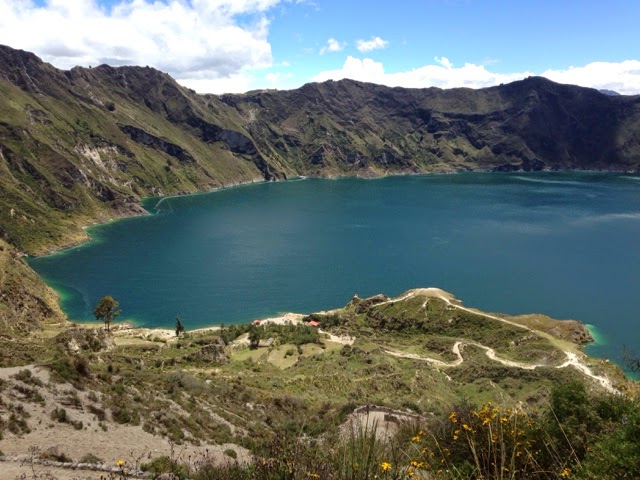
 Next up was Parque Nacional Cotopaxi, home to the active snow capped cone of Volcán Cotopaxi, Ecuador's second-highest peak standing at 5897m. Along with our tour guide we made it through the eery mist to the first refuge point from which we began the hour ascent to the second refuge and then further on to the staggeringly huge glacier slowly forcing its way down the side of the volcano. As we heard many times en route from fellow climbers, the terrain is 'just like' the moon with jagged boulders protruding from black fine sand next to vast ravines filled with red solidified lava. Cotopaxi delivered my first experience with a glacier and it didn't disappoint. We hopped over streams of melting ice water and negotiated crevasses until we were actually inside the glacier; a surreal experience.
I am soon realising that when climbing to heights of around 5000m altitude sickness is a serious danger. Acclimatisation is key but even so we passed several people collapsed by the side of the trail suffering with dizziness, shortness of breath and crippling headaches - a scary reminder of how beautifully dangerous Ecuadorean mountain ranges can be.
Subscribe to:
Posts (Atom)